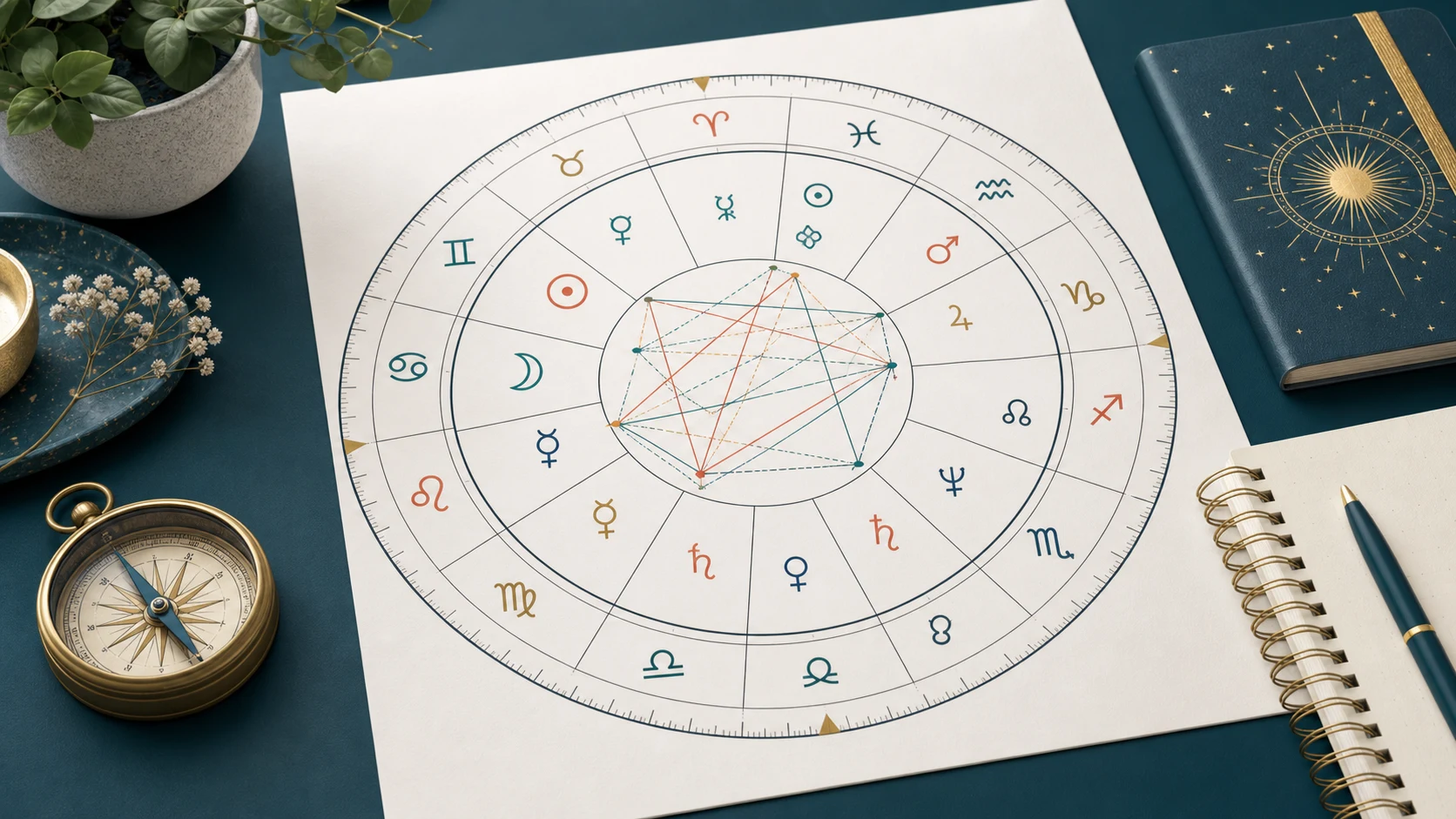
To read a birth chart as a beginner, move through five layers instead of trying to interpret every symbol at once: start with the Sun, Moon, and Ascendant; identify each planet's role; read the sign as a style; read the house as a life area; then connect the strongest aspects. Keep the recorded birth time and the calculator's house system visible, because uncertainty in either can change the Ascendant and house placements.
Before interpretation, check the inputs
A natal chart maps calculated celestial positions for a date, time, and place. The date anchors the planetary positions. The recorded local time and birthplace allow the calculator to convert civil time correctly and calculate the local horizon, Ascendant, Midheaven, and house cusps.
Use the time written on an official record when possible. Do not manually subtract daylight-saving time unless a calculator specifically asks for a converted value. Historical time-zone rules change by place and year, so the software should perform that conversion.
If the birth time is unknown, you can still inspect the Sun and many planetary sign positions. Mark the Ascendant and houses as unknown rather than inventing a time. The Moon may also require a boundary check when it changes signs during that date.
Layer 1: begin with the Big Three
The Big Three are the Sun, Moon, and Ascendant. In astrological tradition, they provide a compact starting structure:
- Sun: themes of identity, direction, and conscious priorities.
- Moon: themes of emotional habits, comfort, and familiar responses.
- Ascendant: the eastern horizon at the birth moment, often used to frame approach and presentation.
Read these as symbolic prompts, not fixed personality facts. Write one observation for each placement and compare it with lived experience. When the exact birth time is uncertain, do not rely on the Ascendant.
Layer 2: identify what each planet represents
Planets are the "what" of the chart. Traditional interpretations assign each one a category of action or attention: Mercury to communication and learning, Venus to values and relating, Mars to effort and assertion, Jupiter to growth and meaning, and Saturn to limits and responsibility.
Do not read a planet by itself. "Mars" is not a complete interpretation. Its sign describes how the theme is expressed, its house points to where it may be noticed, and its aspects show which other chart factors connect with it.
Layer 3: read the sign as a style
Signs describe an interpretive style rather than an outcome. A useful sentence template is:
Planet expresses its theme through the style of sign.
For example, "Mercury in Taurus" can prompt questions about a deliberate, concrete, or steady communication style. It does not prove that someone is slow, stubborn, or destined to communicate in one way. Prefer neutral language and look for examples from real behavior.
Layer 4: read the house as a life area
The twelve houses divide the local chart into areas traditionally associated with topics such as self, resources, communication, home, creativity, work, partnership, shared matters, study, public life, community, and retreat.
A planet in a house does not guarantee an event in that area. It simply gives the interpreter a place to ask more specific questions. Venus in the tenth house, for example, may invite reflection on values, relationships, or aesthetics in public life; it does not promise fame or a particular career.
House placements can differ between calculators because astrology software supports several house systems. Compare charts only after confirming that both tools use the same system. A different house result is not automatically a calculation error.
Layer 5: connect the strongest aspects
Aspects describe angular relationships between chart factors. Beginners can start with conjunctions, oppositions, squares, trines, and sextiles. Instead of labeling an aspect as simply "good" or "bad," ask how the two themes might cooperate, compete, repeat, or require adjustment.
Start with aspects involving the Sun, Moon, Ascendant, chart ruler, or a planet repeated elsewhere in your notes. Use the orb displayed by the calculator consistently. Avoid interpreting dozens of minor aspects before the main pattern is clear.
A five-sentence practice reading
Use this sequence to keep a first reading manageable:
- The Sun, Moon, and Ascendant suggest three starting themes.
- One planet appears especially prominent because of its house or repeated connections.
- Its sign describes a possible style of expression.
- Its house identifies a life area for reflection.
- Its strongest aspect adds tension, support, or a need for integration.
Then add a sixth sentence about uncertainty: note an approximate birth time, a sign boundary, the selected house system, or any placement you could not verify.
Open the free ZodiaGlow birth chart calculator and keep the result beside this method. Read one layer at a time instead of treating the chart as a verdict.
Method and sources
- JPL Horizons documents time-based ephemerides and selectable time scales for solar-system positions.
- Swiss Ephemeris documents planetary calculations, Ascendant and house calculations, and multiple house systems used by astrology software.
- IANA Time Zone Database records historical civil-time offsets and daylight-saving rules used by software when converting local times.
These sources support the calculation layer. The meanings assigned to planets, signs, houses, and aspects are astrological traditions, not scientifically established personality measures or predictions.
Calculate first, interpret second
Generate your birth chart with houses, verify the inputs, and write only five sentences on the first pass. A useful reading should preserve uncertainty, invite reflection, and leave room for personal choice; it should not diagnose health, guarantee a relationship or financial result, or replace professional advice.